Craft
Editing is the department you notice only when it fails
A cut is a decision about attention. Most of what people call pacing is somebody choosing when to look away.
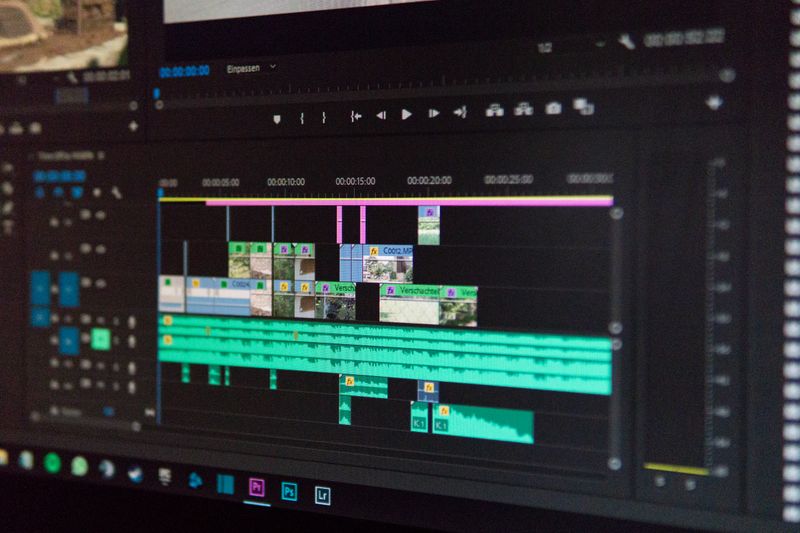
Most explanations of film editing stop at the point where it starts to matter. This one carries on.
The short version
- A cut redirects attention, and the reason for it is what makes it invisible.
- Continuity conventions exist to prevent the audience noticing the join.
- Pacing is rhythm across scenes, not speed within them.
A cut answers a question
The reason an edit feels invisible is that it arrives at the moment the audience wants to look somewhere else. A cut that lands before that question forms feels abrupt; one that lands after it feels slow. This is why the same footage cut two ways produces completely different scenes with identical performances.
Editors describe their job as managing where attention is, which is a more accurate description than assembling shots.
Continuity rules are perceptual, not aesthetic
The line of action, matching eyelines and consistent screen direction all exist to stop the viewer having to re-establish spatial relationships. Breaking them costs a fraction of a second of confusion, which is enough to pull somebody out of a scene. They are broken deliberately and effectively in plenty of films, and the effect works precisely because the convention is otherwise reliable.
The clearest case is two shots of the same subject taken from too similar an angle, which reads as a fault rather than as a transition, and it is why coverage is planned in distinctly different sizes in the first place.
Pacing lives between scenes
A film described as slow often has scenes of ordinary length arranged so that nothing accumulates. Pacing is the rate at which information and consequence arrive, which is a structural property rather than a shot-length one.
This is why trimming individual scenes rarely fixes a film that drags, and restructuring often does. Audiences reliably report that a film felt long and unreliably report where, because the absence of accumulation is experienced as duration and gets attributed to whichever scene was playing when it was noticed.
Sound leads picture more often than not
Bringing audio from the next scene in early, under the outgoing picture, smooths a transition and is used constantly. The audience registers the change as gentle because one channel has already moved.
Almost every transition described as elegant involves this in some form. The reverse works differently: holding the outgoing sound under an incoming picture keeps the departed scene pressing on the new one, which is how a film shows that a character has not stopped thinking about something.
The edit rewrites the film
Scenes are reordered, characters are reduced, subplots are removed and voiceover is added in the edit far more often than audiences assume. This is normal practice rather than a sign of trouble, and many well-regarded films were substantially reshaped after shooting.
By the second act, it is also why credit for a film's structure is genuinely shared and difficult to attribute cleanly. The limit is coverage, since an editor can only build from what was photographed, and a structural problem discovered in the cutting room may be unfixable without going back to shoot more.
Release strategies shift between territories, so your experience may differ.
What an assembly actually looks like
The first version cut from everything shot runs far longer than the release version and contains each scene as written, in script order. It is a working document rather than an early draft of the film, which is why it is not shown outside the production and why leaked versions are so misleading. Everything after that is subtraction under rising resistance, because each remaining scene has somebody defending it and the cost of removal grows as the film gets better.
It also explains why deleted scenes on a release are so rarely revelations: most were removed for being the third scene to make a point already made twice.
The takeaway
Watch where your attention goes at each cut. That is the editor working.
Craft is the part that keeps working after the surprise has gone.
Questions readers ask
What is the 180-degree rule?
Keeping the camera on one side of an imaginary line between two subjects so their screen positions stay consistent. Crossing it makes characters appear to swap sides.
Why do some films feel long despite a short runtime?
Usually structure rather than length — if consequences do not accumulate, scenes feel disconnected and time is perceived as longer.