Craft
Camera movement is a verb, and it needs a reason
A moving camera changes what a shot means. The difference between a dolly, a crane and a handheld frame is a difference in point of view.
The theory of camera movement is well covered elsewhere. This is about the version you meet in practice.
What holds up in practice
- Movement motivated by an actor is read as invisible; unmotivated movement is read as authorial.
- Handheld and stabilised movement produce different relationships to the subject.
- A push in changes emphasis without the audience noticing a cut.
Motivated movement disappears
A camera that moves because an actor moves is not perceived as moving at all, because the frame relationship stays constant. A camera that moves while everything else is still announces itself and is read as a comment by the film rather than an observation. Both are legitimate; confusing them is what makes movement feel arbitrary.
This is the single most useful distinction for watching how a scene is shot.
The slow push is the workhorse
A gradual move toward a face over the course of a speech increases emphasis continuously without requiring a cut. Audiences almost never notice it happening and reliably report the moment as more intense. The reverse — a slow pull back — creates isolation or revelation depending on what enters the frame.
These are among the oldest devices in the medium and remain effective because they operate below conscious attention.
Stabilised and handheld mean different things
A stabilised rig glides with no vertical bounce and reads as observational, detached or dreamlike depending on speed. Handheld carries the operator's body and reads as present, subjective and unstable, which is why it dominates documentary and combat sequences. The convention is learned rather than inherent, and it has drifted: handheld now reads as realism largely because news and documentary trained audiences to read it that way.
Deliberately mixing the two within a scene marks a change in perspective and is used exactly that way.
Height and lens set the relationship
Camera height relative to eyeline determines whether a subject is looked up to, met or looked down on, and audiences read this consistently. Combining height with lens choice changes the effect substantially, since a wide lens low to the ground exaggerates the whole geometry. Neutral choices — eye height, moderate lens — are choices too, and they read as observational rather than as absent style.
A film that never varies these is making a statement about distance whether or not it intends to.
The oner buys continuity and costs coverage
An extended unbroken take preserves real time and spatial continuity, which produces tension because the audience knows nothing can be hidden. It also eliminates the editor's ability to fix performance, timing or a technical error, so the whole take must succeed. These sequences require extensive rehearsal, choreographed crew movement and frequently hidden joins that make several takes read as one.
In practice, the technique is a resource decision as much as a stylistic one, since rehearsal time has to come from somewhere.
Budgets and schedules here are reported rather than confirmed, and studios rarely correct them.
Movement in television is a schedule question
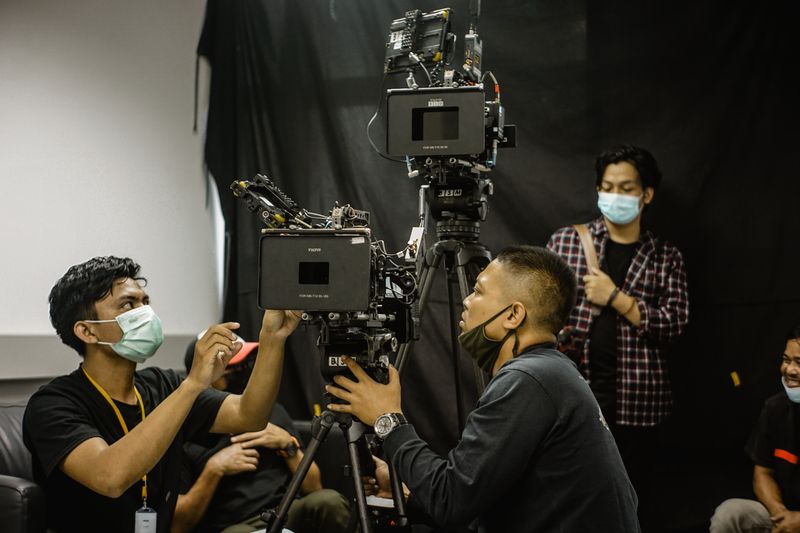
Complex camera moves require lighting the whole space and blocking to a track, which costs hours a television schedule often does not have. This is why episodic television leans on cleaner coverage patterns and why a series with ambitious camerawork is signalling its budget. Directors working across both formats describe this as the sharpest practical difference between them.
Watched twice, the constraint is time on the day rather than talent or ambition.
The takeaway
Ask why the camera moved. If nothing on screen caused it, the film is speaking.
Craft is the part that keeps working after the surprise has gone.
Questions readers ask
What is the difference between a dolly and a zoom?
A dolly physically moves the camera, which changes the spatial relationship between foreground and background. A zoom changes focal length from a fixed position, which magnifies without changing perspective. They look different for that reason.
Why is so much television shot handheld?
Partly convention and partly speed — handheld operating can follow blocking without laying track, which saves setup time on a compressed schedule.