On Screen
Where people stand is the first draft of the scene
Blocking decides what the camera can see, what an audience infers about power, and how long the day will take. It happens before a single frame is exposed.
Most explanations of blocking and staging stop at the point where it starts to matter. This one carries on.
The short version
- Blocking is agreed on set and determines what coverage is possible.
- Movement motivated by a character objective reads differently from movement invented for the camera.
- Static staging is a choice with its own effects, not an absence of one.
The rehearsal that decides the day
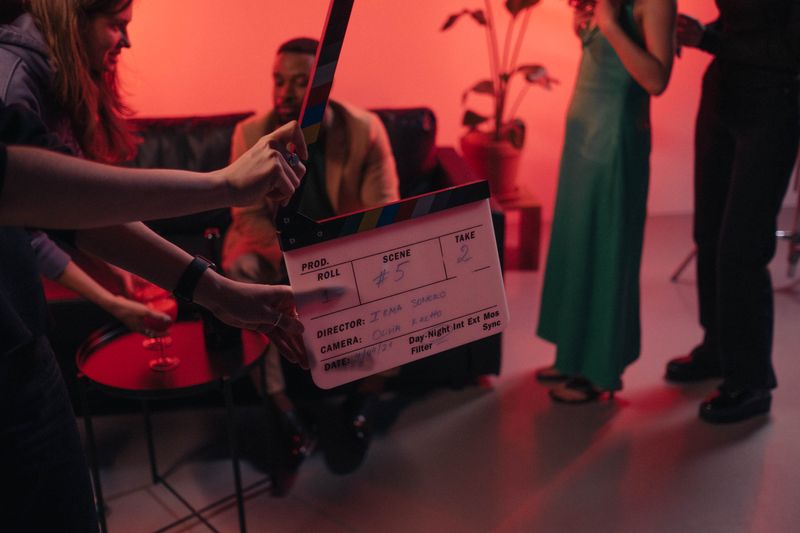
Most productions begin a scene with a blocking rehearsal in which performers walk the action while the director, cinematographer and heads of department watch. What is agreed there fixes where the camera can go, where lights can stand and how many setups the scene will require. Because every subsequent decision follows from it, this brief rehearsal is disproportionately consequential relative to how casual it looks.
Crews wait outside during it precisely so that nothing is committed before the performers have found something honest. When a scene is failing on the day, experienced directors return to blocking rather than to line readings.
Movement needs a reason the character would recognise
Actors moving because a shot requires it tend to look like actors moving, and audiences detect the artificiality without identifying its cause. Giving the movement a purpose the character has, such as leaving, fetching, avoiding or approaching, makes the same geography read as behaviour. This is why physical business is so often invented in rehearsal, since an ordinary task supplies motivation for the positions the scene needs.
The technique also solves the perennial problem of what to do with hands, which is a real difficulty in dialogue scenes shot close. The result is a scene where staging and psychology are the same thing rather than two systems negotiating.
Geometry states relationships without dialogue
Height, distance and orientation are read instantly, so a character standing while another sits establishes an asymmetry no line has to describe. Distance between two people over the course of a scene tracks the relationship more precisely than most dialogue can. Turning away mid-sentence, blocking a doorway or refusing to sit are all decisions that carry meaning at the speed of vision.
These readings are learned rather than universal, and conventions of personal space vary considerably between cultures and periods. Even so, within a single film the internal consistency of its spatial rules is what allows an audience to read them at all.
Blocking determines coverage, and coverage determines options
A scene staged across a wide space needs more setups to cover, which costs hours and may reduce the number of takes available for performance. Staging that keeps performers in a shared frame allows longer takes and gives the editor fewer options but more continuous acting.
On screen, directors who prefer to solve scenes in the edit tend to block for separation, while those who prefer the room to work tend to block for togetherness. Neither approach is superior, and the choice announces itself in the finished film through how often the audience sees two people at once.
Schedule pressure pushes towards simpler staging, which is one of the quieter ways budget shapes what a film feels like.
Stillness is a decision too
A scene where nobody moves concentrates attention on faces and language, and it can generate considerable tension by withholding the release movement provides. The risk is inertia, which arrives when stillness is a default rather than a choice and the scene has no internal development to sustain it. One reliable structure is stillness broken by a single decisive movement at the moment the scene turns, so the geography marks the change.
What the cut is doing: long static takes place enormous demands on performance, since there is nowhere to cut and nothing to hide behind. This is why they tend to appear in productions with rehearsal time and experienced casts rather than in rushed schedules.
Release strategies shift between territories, so your experience may differ.
The camera is part of the staging
Blocking and camera movement are designed together, because a performer crossing left and a camera drifting right produce a different effect from either alone. Handing the movement to the camera lets the actors stay still, which is often the solution when a location will not accommodate walking.
In practice, reframing within a shot can replace a cut entirely, keeping two performers in the same continuous time while shifting the emphasis between them. The reverse is also true, and a scene can be staged so simply that all the variation comes from where the camera chooses to sit. Reading a finished scene backwards from what the camera does usually reveals the staging logic that produced it.
The takeaway
Watch where people stand before you listen to what they say. The scene is already there.
The trailer sells a premise. The film has to survive its own middle.
Questions readers ask
Why do directors rehearse blocking before the crew arrives?
Because everything else follows from it. Once positions are agreed, the lighting plan, the camera positions and the number of setups are largely determined.
Is a scene with no movement badly staged?
Not necessarily. Stillness concentrates attention and raises the demand on performance. It fails only when it is a default rather than a decision.