Craft
Aspect Ratio Decides What Gets Left Out
The shape of the frame is a compositional constraint chosen in preparation. It governs how faces are staged, how much environment intrudes and how a cut feels.
The shape of the frame is chosen before shooting and cannot be meaningfully changed afterwards. It determines what fits beside a face and what has to be excluded entirely.
Width changes what a close-up contains
In a wide frame, a face in close-up leaves substantial space either side. That space has to be filled with something, or deliberately left empty as a statement.
A taller, narrower frame surrounds the same face with less environment, which isolates the performance and makes the shot feel more contained.
Neither is inherently better. The choice determines whether the audience reads a character as embedded in a place or extracted from it.
Wide frames prefer arrangement to cutting
A wide shape comfortably holds two people at a distance, so a conversation can play in one frame with the tension carried by the gap between them.
Narrower shapes push productions towards cutting between singles, because staging two faces side by side quickly fills the width.
This is why aspect ratio influences editing rhythm. The frame decides how much can be said without a cut, and therefore how often cuts are needed.
Vertical space is the underrated variable
A taller frame can hold a ceiling above a character or a floor below them, both of which carry meaning about pressure and scale.
Wide formats trade that away. Landscape and horizon are gained, but a low ceiling pressing down on someone becomes difficult to show without moving the camera closer.
Directors working in wide shapes therefore use foreground objects to close the top of the frame, recreating the confinement the ratio has removed.
The decision constrains every department
Set builders need to know how much wall will be seen at the edges of a wide frame, and how much ceiling a tall one will reveal.
Lighting is affected too, since a wider frame gives fewer places to hide instruments just outside the picture. Sources have to be further away or built into the set.
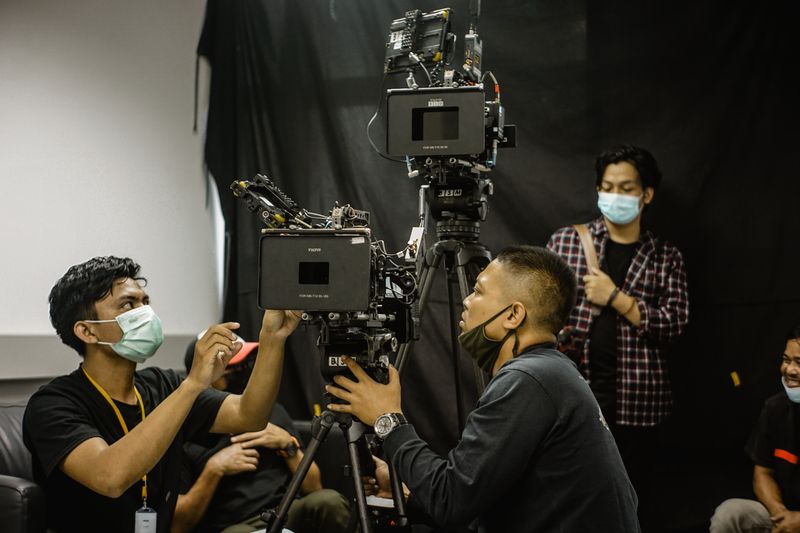
Camera crews mark their monitors for the chosen shape, and everyone judges composition through it, which is why a late change is treated as a serious disruption.
Ratios change again on delivery
A film composed for a cinema screen is shown on televisions, phones and seat-back displays with different shapes, and something must give at each step.
The usual approach is a version supervised by the filmmakers, preserving the intended composition with bars rather than cropping into it.
Some productions shoot with a protected area, framing so a later crop remains usable. That protection is a compromise agreed early, and it quietly limits how tightly the wide version can be composed.
Questions readers ask
Does replaced dialogue mean the original performance was bad?
Usually not. The most common cause is uncontrollable location noise, and the aim is to preserve the take that worked visually.
Why do dubbed versions sometimes say different things from the subtitles?
Dubbing has to fit mouth movements and timing; subtitles have to fit reading speed. Each compromises differently, so they diverge legitimately.