Craft
Weapons On Set Move Through A Separate Chain Of Custody
Firearms and blades on a production are controlled by a dedicated department with its own handover procedure, because safety on set depends on custody rather than on individual care.

A prop firearm on an American set is not simply handed to an actor. It moves through a controlled sequence of checks and handovers run by a specialist department, and the procedure exists because attention alone fails.
Custody is the safety system
The central principle is that a weapon has one responsible holder at any moment, and every transfer is deliberate, announced and witnessed. Nothing is left on a table for whoever needs it.
That is why the same object is checked repeatedly through a day. A weapon that leaves someone's hands is treated as unknown when it returns, regardless of who was holding it.
The system is built to survive fatigue and distraction, which are ordinary conditions on a long shooting day. It does not rely on anyone remembering what happened an hour earlier.
The armorer is a department, not a prop assistant
Weapons work sits with a specialist who sources, maintains and controls everything in that category, and who is present whenever the item is on the floor.
Their work starts long before the shoot, in choosing what a character carries, confirming it suits the period and deciding whether it needs to function at all.
Much of the job is refusal. A shot that would require an unsafe configuration gets solved with an angle, a cut or a visual effect instead of with the object itself.
Most on-screen weapons never fire
Productions carry several versions of the same object: a non-firing replica, a rubber version for stunts and fight work, and occasionally a functional one for a specific effect.
The replica does most of the work. It photographs identically at normal shooting distances and removes an entire class of risk from scenes that only need it to be visible.
Muzzle flash, recoil and impact are increasingly added afterward. The performance is captured with something inert and the consequence is built in post-production.
Rehearsal is where the sequence is fixed
Any scene involving a weapon is walked through slowly before it is shot, with the department and the stunt coordinator establishing exactly where everyone stands and where anything is pointed.
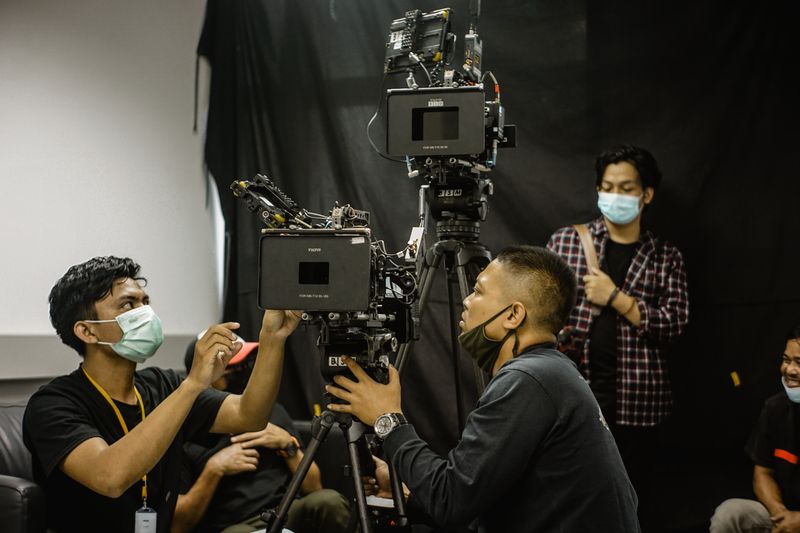
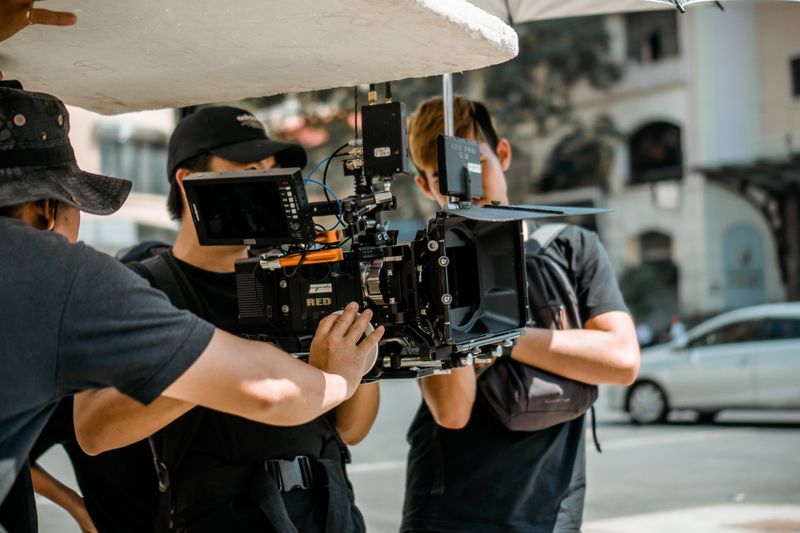
Camera positions are part of that rehearsal. A shot that appears to look down a barrel is usually achieved with an offset lens position and a locked frame, not by placing an operator there.
The blocking is then treated as fixed. Improvised movement in the middle of such a scene is a safety problem before it is a creative one.
Blades and period weapons follow the same logic
Swords, knives and axes are handled with the same custody rules, and are usually dulled or made from materials that cannot hold an edge.
Sharp versions exist for close inserts where nothing is moving quickly, and they are brought out for that shot and taken away immediately afterward.
Fight choreography is built around what the performers can repeat safely at speed, which is why screen fights use wide arcs and clear separation that would be useless in a real one.
Questions readers ask
Does replaced dialogue mean the original performance was bad?
Usually not. The most common cause is uncontrollable location noise, and the aim is to preserve the take that worked visually.
Why do dubbed versions sometimes say different things from the subtitles?
Dubbing has to fit mouth movements and timing; subtitles have to fit reading speed. Each compromises differently, so they diverge legitimately.