Craft
Grips build the machine the camera rides on, then hide it
One department moves the camera and shapes the light without switching anything on. Its work is structural, and the point is that you never see it.
This is less a set of instructions about grip and rigging than an argument, and it is worth saying so at the start.
The argument in brief
- Grips handle movement and light control; electricians handle power and lamps.
- Most lighting control is subtraction — flags, nets and negative fill rather than more light.
- Rigging is load-bearing construction built and struck inside a single shooting day.
Movement is a construction problem
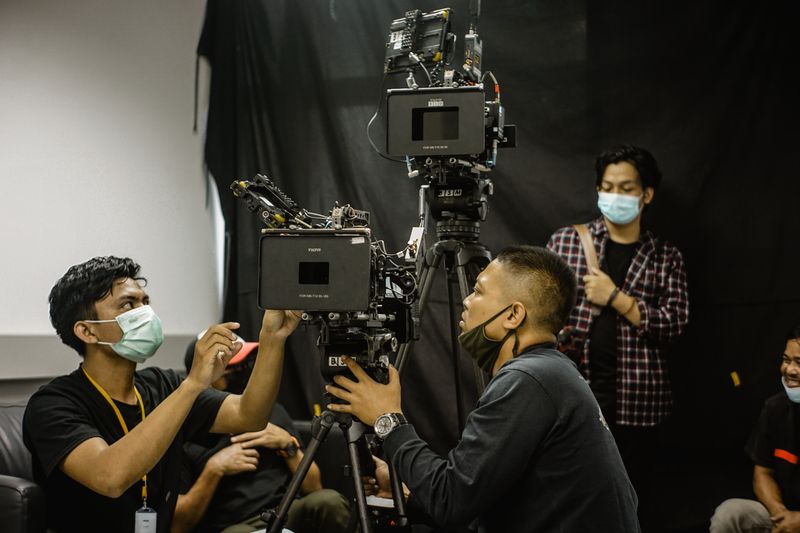
A camera that glides across a room is usually sitting on a wheeled platform running on laid track, levelled with wedges until the move is smooth. Laying that track on an uneven floor, a lawn or a staircase is carpentry performed against the clock while everybody else waits.
Cranes, jibs and remote heads extend the same idea upwards, and each one has counterweights, load limits and a footprint that has to fit the location. The reason a move looks effortless is that a crew spent an hour making a surface that behaves as though it were perfectly flat. When a move cannot be built the shot is redesigned, which is why blocking often changes after the grips have looked at the room.
Shaping light is mostly subtraction
The distinction that confuses outsiders is simple: electricians provide and power the lamps, and grips control where the resulting light is allowed to go. Flags, nets, floppies and solid boards take light away from parts of the frame, which is how a face is separated from a wall behind it. Negative fill is the deliberate placement of black material to darken one side of a subject, and it shapes a face more than adding a light usually does.
Diffusion frames and silks soften a hard source by enlarging it, since apparent size at the subject is what determines how gentle a shadow edge looks. Bounce boards do the reverse, turning a hard lamp into a wide soft source by reflecting it off a controlled surface at a chosen angle.
Rigging is load-bearing work with a deadline
Overhead structures that carry lamps, diffusion and sometimes camera weight are built from scaffold, speed rail and clamps rated for specific loads. A greenbed or a rigged ceiling grid lets a set be lit from above so no stands appear in a wide shot that sees the whole room.
The same structure often has to come down the same day, so everything is designed to be assembled and struck quickly without leaving marks on a location. Practical constraints such as ceiling height, floor loading and window position decide more about a lighting plan than taste does. Location rigging in occupied buildings adds a further layer, because the crew is working inside somebody else’s property under conditions agreed in advance.
Handheld, stabilisers and vehicle work
A stabilised rig isolates the camera from the operator so a walking move loses the footfall without losing the sense of a body moving through space. Gimbals achieve something similar electronically and behave differently, since they resist rotation smoothly and can produce a floating quality that reads as unreal if overused. Vehicle work involves mounting a camera to a car, a low loader or a tow rig, all of which are engineering tasks with safety implications.
Each of these choices carries a signature, and audiences read handheld as immediacy and a perfectly smooth float as detachment without being told to.
Choosing the support is therefore a storytelling decision that gets made in a technical conversation between the operator, the cinematographer and the grips.
Safety is the department output nobody credits
Stands, clamps, overhead loads and moving platforms are the parts of a set most capable of injuring somebody, and grips own almost all of them. Sandbagging every stand, using safety cables on overhead fixtures and checking clamp ratings are routines that only look excessive until one of them is skipped. A key grip has standing authority to stop a setup that is unsafe, which is a rare thing in a hierarchy built around keeping the day moving.
Watched twice, rules vary between countries and productions, so anyone working internationally has to learn a new set of local requirements rather than assume the familiar ones. The measure of the department is that nothing happened, which is impossible to demonstrate and easy to underfund.
Craft credits are collaborative, and attributing a choice to one department oversimplifies it.
Why the work is invisible by design
Every successful grip decision removes something from the frame, whether that is a stand, a shadow, a reflection or a bump in a moving shot. Audiences notice the failures instead, in the form of a wobbling dolly move, a lamp reflected in a window or a boom shadow crossing a wall. Because the department produces absences, its budget is among the easiest to cut and the effects of cutting it appear as vague unease rather than obvious faults.
Crew members often describe grip work as problem solving rather than image making, which undersells how much of the final look it determines. The next time a shot feels calm and clean, most of the reason is a structure that was built, used and taken away before anyone saw it.
The takeaway
If a shot feels clean and calm, somebody built a structure and then removed it.
The trailer sells a premise. The film has to survive its own middle.
Questions readers ask
What is the difference between a grip and an electrician on set?
Electricians supply power and place the lamps; grips control the light once it exists and handle everything the camera sits on or moves along.
Why do lighting crews block light instead of adding more?
Because contrast is what shapes a face and a room. Taking light off one side with flags or black material sculpts far more precisely than adding another source.